Showing posts with label Soap Colors. Show all posts

Wednesday, December 17, 2014

Let's Talk Soap Colors!

It's just my opinion, but I believe Go Planet Earth (GPE) and Mold Market (MM) have some of the best soap colors on the market. Just take a look at some of the color intensity intensity that you can achieve with our liquid gel colorants.

I think many of my long-term customers will agree it's hard to beat the color results you get with our Neon Brights.

Look for an upcoming tutorial that showcases the technique used to make these colorful layered soaps. All were made with Mold Market molds.


Saturday, March 22, 2014

Soap Making: Employee Training Session


It's been a while since I've been in the soaping room. It felt good to get my hands dirty, or is that clean, again. My assistant, Jenni, wanted to learn more about the process of melt and pour soap making. I love when workers show an interest in learning the techniques we promote on our web site.

This loaf soap was made with Mold Market's Square Loaf mold. Both white and clear soap was used in the training process of pouring in layers. Jenni choose a mango scent to complement the tropical colors of orange, red and yellow.

Here are a few key points Jenni learned about pouring a layered loaf soap:

  • Let the first layer cool until a somewhat thick skin forms on the surface of the soap. This is especially true when pouring a white/colored layer of soap over a clear layer.
  • If the soap is too hot when poured, it will penetrate the previous layer. You won't get defined color lines when that happens.
  • Time and temperature are the key factors to successfully pouring layered soap.
  • When using clear soap base, it is imperative to also use a clear fragrance oil. Some fragrance oils are tinged yellow, green or orange and will discolor your clear soap base.
  • Spritzing each layer with rubbing alcohol removes any air bubble and helps the next poured layer to adhere to the previous layer.
  • Add 1 teaspoon of fragrance per 8 ounces of soap base (if using GoPlanetEarth products).
  • Pouring temperature of soap should be 140 degrees or less.
I must say Jenni's first attempt at a semi-advanced soap making project was a success. She is excited about moving on to more advanced projects.


Friday, October 04, 2013

Powdered Color Fun for Hair!


If you thought powdered colorants were just for soaps, think again! It was crazy hair day at my grandkids' school for homecoming week. And guess who was elected (by the grand kids) to give them something crazy looking; ME! Their mommy (my daughter) just wanted to plop a Halloween wig on their head, but they would have nothing to do with that.

"NeeNee (that would be me) will do something fun for us." And so, these pictures give you my idea of fun with a few added touches by the kids.
 
Pictured above is my granddaughter, Olivia. She was thrilled with the Monster High look. She picked out the colors and I applied with a small paintbrush. Thankfully, she won't be showering at my house tonight. It's going to take more than one shampoo to get those colors out, but she wanted to go for the WOW factor. To my daughter I say, "Your mom colored, you can shampoo!"


The boys opted to make their own crazy hats to wear, but we colored their hair just in case they removed the hats. Carson's crazy hair hat is made from a nylon stuffed with tissue paper and sprayed pink (colored hair spray). I glued green paper shred to the cap with a hot glue gun. Ribbon bows were tied at the end of the pigtails.


My little buddy, Fischer was the most excited about this school event. He just started kindergarten this year, so all of this is new for him and he loves being included in the fun. He decided on a pair of stripped tights from one of NeeNee's old costumes. And yes, those are socks hanging from the cap; his idea.

A word of advice when using powdered pigments to color hair.... IT CAN BE MESSY! Hair chalk can also be used, but I didn't have time to make it. It is best done outside with a towel wrapped around the neck and shoulders. The dry powder does come out of clothing in the wash, so if a small amount colors a shirt or collar, don't get too stressed.

I used GoPlanetEarth's Neon Bright Colors for this hair project. Colors can be purchased here. With Halloween just around the corner, consider a creative hair project using powdered pigments.

Sunday, July 07, 2013

Melt & Pour Soap Making: Splatter Loaf


Melt and Pour Soap Making: Splatter Loaf

Check out Sophie Soap Chick's splatter soap slices. I'm quoting Sophie, "So many different color options and I had a blast!"

 
This is a really easy soap to do with kids on a rainy day or at a children's birthday party. I personally think it is less mess than finger painting. Roll out a big sheet of Kraft paper onto a table and let the kids do their magic. 
 

Make a soap loaf using Mold Market's square loaf mold and white melt and pour soap base. Fill the loaf mold to the very top (about 2- 2 1/2 pounds of soap base. Once the soap is set up, remove from mold and slice with our miter box and wavy soap cutter.

Set the soap slices to the side while you prepare the different colors of soap for splattering. Use a straw or plastic spoon, flick the colors onto the soap slices. Flip the soap over and do the same to the other side.
You can also spread the colors onto the sides of the soap slices to add more color.

Clear soap base was used for all of the splatter colors. Here is a list of the colorants Sophie used:
  • Neon Blue
  • Neon Green
  • Neon Orange
  • Neon Red
You will find all of the above colors here.
 

Saturday, March 09, 2013

Tye Dye Milk Art


I spent some one-on-one time with my nine-year old granson. He loves science and art and our Saturday morning project incorporated both.


We started by pouring milk onto a large plate. Make sure the plate is able to contain the liquid. Next, a dropper was used to disperse assorted food grade colorant on to the milk.

Make sure you rinse the dropper between each color. We used approximately 8-10 drops of each color (pink, red, orange, yellow, green, blue).

The next step is to place a few drops of dish soap in the center of the plate. The blue color Dawn dish soap worked well.

As you can see, the application of dish soap immediately caused the colors to explode into a tie-dye pattern.


Another few drops of dish soap caused even more color explosion. You can swirl the colors with a toothpick or wooden skewer to create awesome color displays.

Don't over mix the colors or you'll end up with a muddy looking color. Once you achieve the perfect mix, snap photos that you can later edit in a photo editing program.

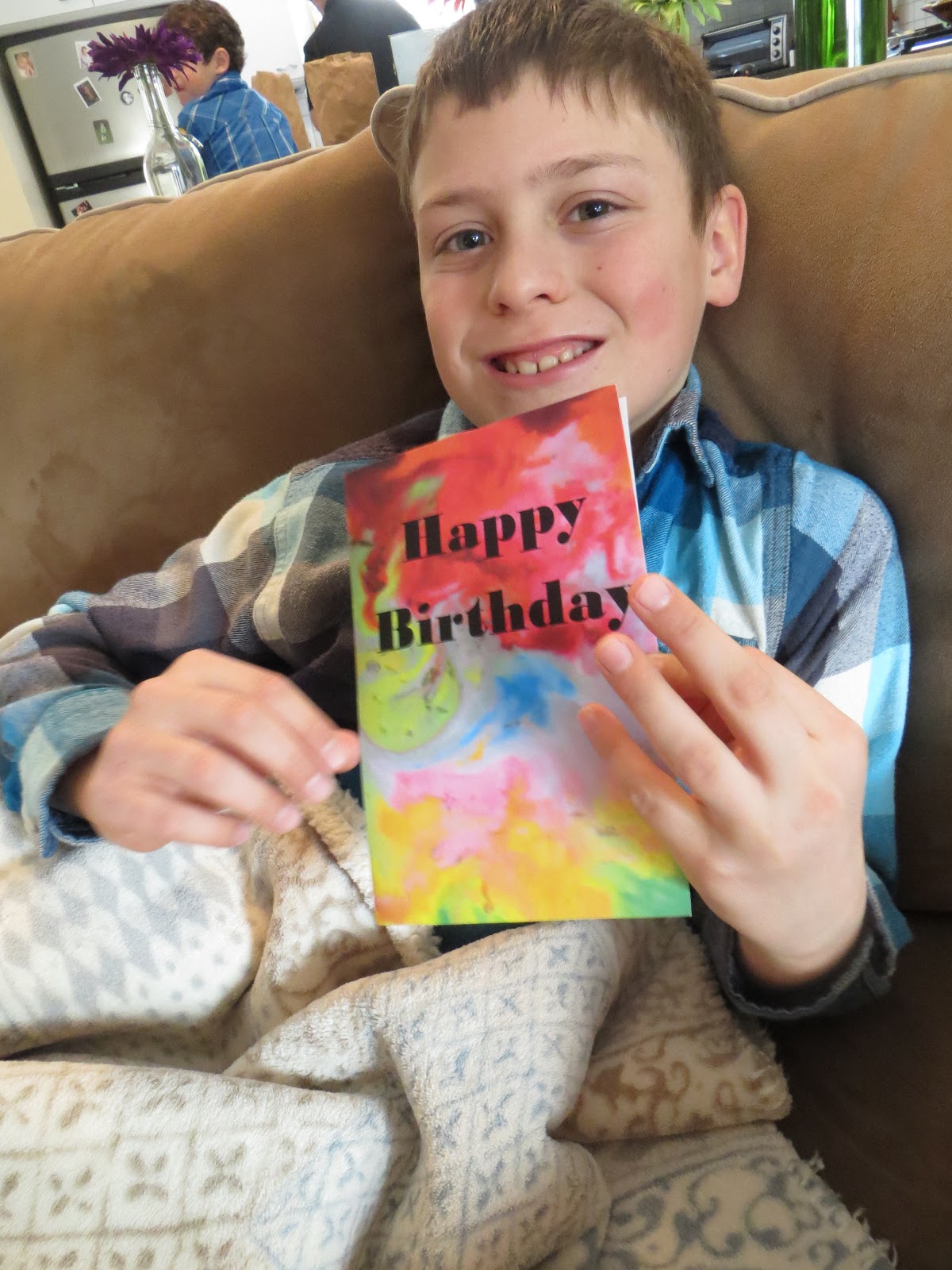
My grandson and I used MS Publisher and resized the photo to fit onto 8 1/2 x 11" white card stock. This was a birthday card, so we added block text lettering and scored the card for folding.


My grandson, Carson, was delighted with the final look of his card. The best part was knowing it was a card he created himself. He will have great pride in presenting to Grandma Mike on his birthday.

This entire project took less than 30 minutes. Don't underestimate the power of spending time with your kids or grand kids. This half  hour was a time of bonding with my grand son while creating something uniquely his own.
 

The food-grade colorants can be purchased at GoPlanetEarth. We offer colors not readily available at your local food market.

Carson hand-printed his message inside the card and will give to his Grandpa Mike tonight at dinner.


Wednesday, January 23, 2013

Melt & Pour Soap: 3-D Floral Tutorial


I recently had a new desktop installed in my office which required the services of our tech people. One of my favored programs could not be transferred to my new computer. I purchased an upgraded version and, holy sugar, it was a pain to learn.

I conquered the software, but it took time. Here is one of my newest tutorials using that software. Hope you enjoy! Thanks to Gabby for taking my idea and running with it.

Gabby
The colors used in the above design are:

Neon Bright Blue (perched bird)
Neon Yellow, Flower Child Rock Me Raspberry, Lavender (flowers)
Neon Green (leaves and border)
Flower Child Tye Dye Orange (winged bird)
Brown Oxide in clear soap (branches)

The are so many design options for this soap. Use a plain oval, square or rectangle shapes to create an entirely new floral look.

I was a bit concerned how this soap would wrap, but there were no issues. I cut the stretch wrap to size, gently pulled it around the soap, taped the back side and used a low setting on my heat gun for a snug fit.


Purchase the new silicone border mold we used here. Everything needed for this project is available online at www.GoPlanetEarth.com.

Tuesday, November 27, 2012

Soap Molds: Mold Market Leaves & Berries


This is one of newest Mold Market designs (Leaves & Berries Mold). I've been experimenting with colors to determine what shades I like best. My second test results of Kelly Green and tomato red liquid gels are shown in the above photo. The green and red displayed well against a white soap background.


My first attempt didn't fair well. The green color was too light (pictured above). A few more drops of green colorant deepened the shade and gave the desired result.


You will need to use GPE's injector soap tool with this mold. It was late at night when pouring these soaps. I now wish I would have paid more attention to the mold details. That's what happens when you're pouring soap after midnight. The simplicity of the overall design coupled with the leaf details is awesome. I give this mold a 10. It's a winner!

Melt & Pour: Follow-Up on Overcoloring Soap


In a prior post, I discussed issues with over coloring melt and pour soaps. This follow-up post shows the results of how the same pigment can give different color shades. GPE's Neon Bright Purple was used in this scenario.

The ice cream soap on the left was colored using white soap base. As you can see, the soap isn't even close to purple color. The opacity of the white soap base causes the purple pigment to soften to a pinkish, magenta color.

The center soap is closer to a lavender color. I used the Neon Bright Purple, but added a very small amount of Neon Bright Blue which yielded a soft lavender in white MP soap base.

Pictured right is clear soap with Neon Bright Purple colorant added. It's definitely not a true purple, but more of a mulberry color. To achieve a "true" purple color in clear MP base, you need to add a small amount of Neon Bright Blue.

If you take a close look at the far right soap, you will note that some of the white dots around the inside edge of the mold have faded away. This happened because the second soap layer was poured at too high of a temperature. It melted portions of the white dots causing them to migrate slightly into the purple/mulberry color.


My final test results showed that the Neon Bright Purple did not migrate or have bleeding issues when used relative portions. Adding extra color to deepen color intensity is going to create over-coloring issues. The soap pictured above sat for several days with no signs of color migration.


If you compare the two ice cream soaps, you will note that the second one is WAY over-colored. The Neon Bright Purple should resemble the lighter shade ice cream soap when used in white (opaque) soap base. If you want a "true" purple, use clear soap with equal parts of Neon Purple and Neon Blue colorant.

Wednesday, November 21, 2012

Melt & Pour Soap Making: Can you Overcolor?


I have been working with a customer on a coloring issue. It's one of our faithful non-bleeding liquid gel colors (Neon Purple), but for some reason there are apparent problems. The big question is was the soap base over colored or is there a problem with the color formula. That's the investigative part we are currently working to resolve.


As you can see in the above customer photo, the purple isn't fairing well. The color has migrated into the dove and the square chunks in the loaf slice. In my test run of the purple colorant, I tried to achieve the same shade of purple as shown above in white soap base. I was fairly certain this hue might possibly be a color overkill. Below is what I would expect the Neon Bright Purple color to look like when added to white MP soap base.

Although it may look similar in color, the purple dove background is actually much darker in color. It is close to the over-color we did with our oval Popsicle mold shown below. It was over-colored to the point we actually could use the soap bar as a crayon.


The purple already started bleeding (migrating) onto the white cone after 12 hours. For a soap maker, there is nothing more frustrating than wasting time and materials on soaps that don't return a profit.

This is why GPE takes it seriously when a customer reports a problem with one of our products. Usually it's an easy fix. However, in a case like this, it requires testing on our end and a one on one with our color lab.

What we did discover while working through this color issue, is over-coloring is perfect when making our soap crayons. They actually do yield color that can be used in the tub. My 9-year old grandson tried out the over-colored soaps and was delighted at how well they worked. We will be testing them in the shower over the weekend. Here is what he colored on paper.

A sure way to know you have added too much color to MP soap base it the above scenario; you can use it like a crayon. I'm still not convinced the color migration isn't due to over-coloring. GPE has stocked the Neon Bright Purple for years with no reports of color bleeding. I'll do a few more test batches and report my findings.

Wednesday, July 18, 2012

Coloring Queen Anne's Lace Flowers


How to Color Queen Anne's Lace Flowers

The whole state of Michigan, as well as 60% of the US, is suffering extreme drought this summer. Queen Anne's Lace is one of the few flowers thriving in the heat. It's considered a wild flower but, surprisingly it's a direct relative of the carrots we eat today. In Michigan, it is commonly found in dry fields or along road sides. Most of us never give it the time of day. However, the delicate lacy blooms are a coveted filler in summer wedding bouquets.

One of my staff members is getting married next month. It's a casual outdoor setting and she asked for help decorating the reception tables. Queen Anne's Lace seemed the perfect choice since Mother Nature has provided an abundant crop.


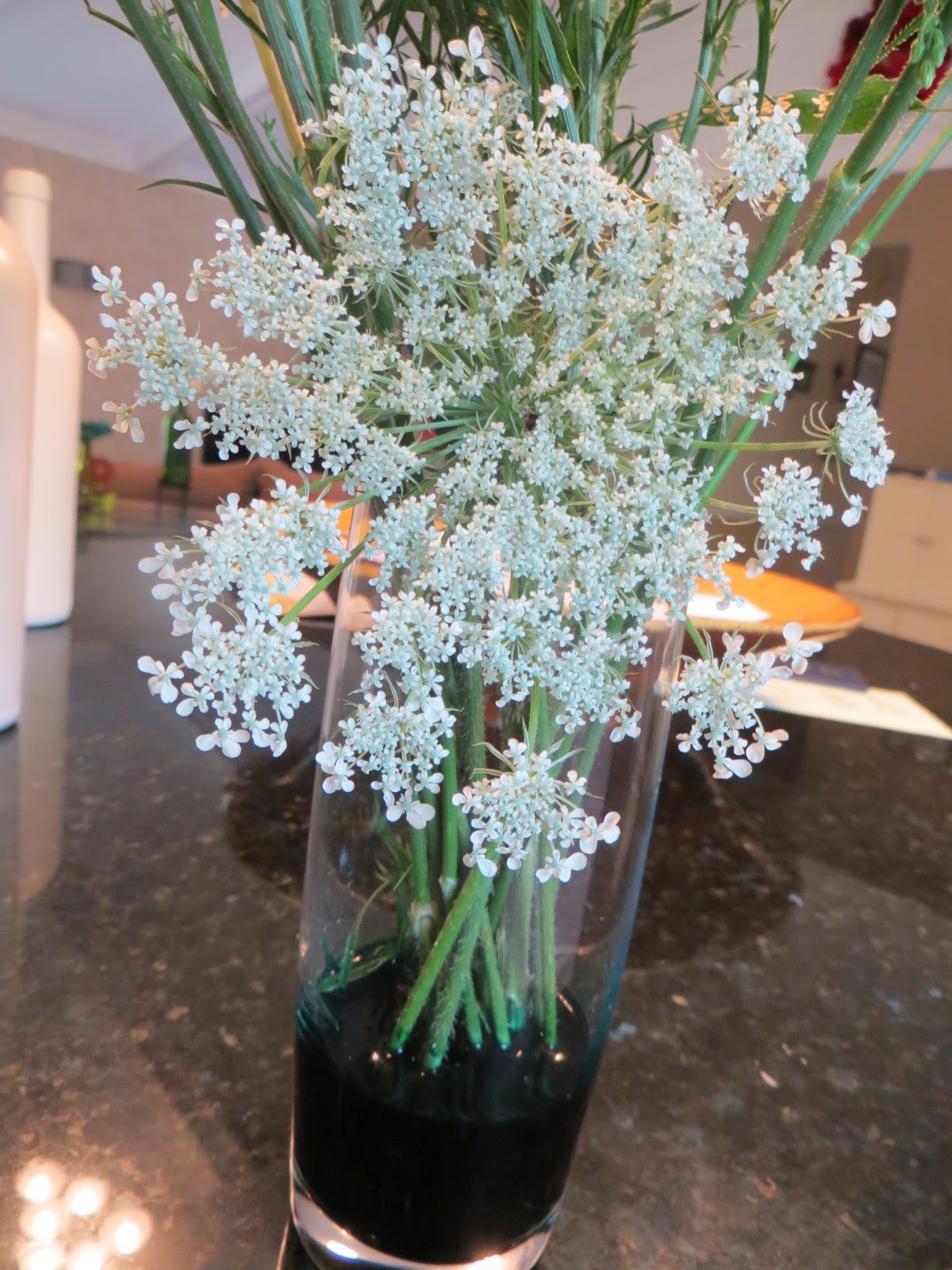
The wedding colors are turquoise and coral. Since this flower readily accepts dye, the petals can be color themed to fit any wedding. Here's a pic of the turquoise flowers. I'm experimenting with a coral color this week. I'm excited to see the trio of white, turquoise and coral flowers intermingled within wild greenery.

Coloring Queen Anne's Lace Flowers

The flowers will display in chalkboard graffiti wine bottles with random placement of crystals and jewels to add conserative 'bling'. Fun graffiti plans are in the works for the wedding guests (can't share at this time).

You may purchase the dye to color these flowers at GoPlanetEarth. Mix 2 parts water to one part dye. Allow flower stems to sit in the mixture for 4 hours, then add additional water. Let stems absorb the dyed water overnight. You'll be surprised with the color change after 24 hours.

TIP: Cut the flower stems at an angle before placing the the colored water.

Wednesday, February 29, 2012

Think Spring, Think Easter


 We've been working on Easter soaps this week. The smaller eggs were made with our plain egg and swirl egg novelty molds. The two halves were joined with clear soap base (spread the melted soap on like glue) and the two pieces joined. My assistant, Kristy drizzled colored soap over the eggs for a finishing touch.

The larger eggs were made using Mold Markets Easter Egg mold. I love this mold because the egg decorations are deep and easily facilitate multiple color pours. All the colors used are from our Neon Bright liquid gel line. As you can see, they produce outstanding color and are all non-migrating colors.


We are working on some fun and creative Easter packaging ideas. I hope to post pictures next week.


I love the golden egg nuggets. Clear soap base was colored with radiant gold liquid gel. The egg halves were joined and dusted with 24 karat gold mica powder. At the last minute, we decided to pour some little Easter bunnies. My grand kids will love them. Check out all our Easter novelty molds on our web site.


Monday, February 27, 2012

Don't Underestimate a Basic Mold


This basic peace sign from Mold Market is an ideal mold to experiment with color and dual color pours. If new to soap making, you will find this mold (and many others from the Mold Market line) a great way to learn how to pour color detail to make your soaps more interesting and colorful.


My staff played with various color combinations to get a feel for how the colorant would look in melt and pour soap base. It was a great learning experience and with the knowledge learned, equips them to assist in answering customer questions/emails about GoPlanet's  liquid gel colors.


Friday, February 24, 2012

Soap Projects Revisited


This morning I am working on a tutorial for using our MP Swirlz soap base. I remembered another project I did a few years back that was featured in the Handcrafted Soapmaker Journal.

The technique is somewhat different than swirling, but yields similar mixed color results. The colors flow together seamlessly due to pouring a variety of graduated colors.


These tropical colors really drew me in today as I sit in my office watching 8 inches of snow accumulate outside (we're under a winter storm watch). Oh to be sitting on a sandy beach surrounded by palm trees with a margarita in hand. Instead, I will soak in a tub filled with sea salt, surrounded by my one lone palm stalk (purchased at Ikea) and sip on sparkling water and dream of warm sunshine.